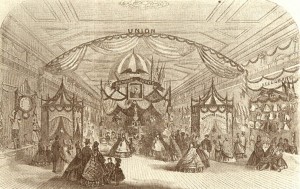
Interior of the Maryland Institute, April 1864
Acting upon the invitation of the women organizers, President Abraham Lincoln agreed to preside over the opening ceremonies for the Maryland State Fair for U.S. Soldier Relief, also known as the Baltimore Sanitary Fair.* Lincoln’s appearance in Baltimore held symbolic importance for city Unionists, and perhaps, to himself. For loyal citizens it offered both a chance to display their devotion to the man who embodied the Union and cast off doubts about Baltimore’s predominant political sympathy. For the President, coming to Baltimore presented an opportunity to make amends for a past indiscretion. In March 1861, en route to his inauguration, Lincoln secreted himself through Baltimore’s darkened streets in response to the rumor of an alleged assassination plot. Already held in low regard by his affiliation with the perceived anti-Southern Republican Party, many residents regarded the President-elect’s distrustful action as an affront to their city’s honor; even Unionists expressed bewilderment. Later, the President “was convinced that he had committed a great mistake.” By opening the Maryland Fair, Lincoln could both mitigate his wrong and express his confidence in the city’s national loyalty.
The city’s population and the Fair officials received President Lincoln with great warmth during his April 18 visit. Upon his 6 PM Camden Station arrival, “the President was loudly cheered by the people at the depot.” The freshly repainted and refurbished great hall of the Maryland Institute hosted the event [located downtown near the inner harbor at this time]. With her arm taking his, Elizabeth Bradford, fair co-chair and wife of Maryland’s Governor, led the President to the speaker’s platform amid the “waving of handkerchiefs and continuous cheers.” While his main speech concerned the deliberate massacre of African American U.S. troops at Fort Pillow, the Chief Executive’s initial remarks at the opening ceremony revealed the significance of his presence. Surveying the faces of the three thousand Baltimoreans before him, and perhaps, reflecting upon the city’s past hostility toward himself and Union soldiers, Lincoln remarked that “the world moves. . . . Blessings upon those men who have wrought this great change, and the fair women who have sustained them.” The outpouring of the Unionists’ enthusiasm towards him, Maryland’s recent movement toward emancipation, and the remarkable setting of the relief fair provided ample evidence for the President’s perception. At the ceremony’s conclusion, “large numbers of ladies and gentlemen made a rush for the privilege of shaking hands with the President.”
The fair site appeared at its peak of splendor the night of Lincoln’s visit. With red, white and blue being a favored color scheme, U.S. flags, carved eagles, framed portraits of Union heroes, and evergreen boughs characterized the general decor. A thousand flickering gas lamps made the great hall’s rectangular space “one grand flood of light.” In the center, just behind the speaker’s platform, rose the Floral Temple. Inside, a gently cascading fountain held numerous varieties of fragrant water flowers within its basin. The White House gardens, through the auspices of Mrs. Lincoln, furnished a continual supply of fresh flowers. At either end of the building space stood a large ornamental arch “gaily decorated with national flags, and surmounted by jets of gaslight.” The German Ladies Relief Association featured a tableau from the Grimm Brothers’ fairy tale “Old Woman in the Shoe.” The Fish Pond, with mirrors for “water” and potted ferns lining its “bank,” captivated eager anglers of all ages with the chance to haul in “a big one.” With a rustic fishing pole one hooked up a small prize package containing, perhaps, a knitting needle, a ring, or a small doll.
Lincoln toured the main hall for two hours with an entourage of fair officials and Washington dignitaries. At the “German Ladies” stand, the member costumed as “‘the Old Woman who lives in a Shoe’ presented President Lincoln with a beautiful bouquet, and was kissed by him in payment.” Though most tables also offered gifts of flowers, the Baltimore County contingent proffered an expensive vase. The Central Relief Association of Baltimore bestowed a prize afghan, valued at one hundred dollars, as a gift for the First Lady. While viewing the Fish Pond, “the President seemed half inclined to bait a line and try his skill.” Leaving the site around 11 PM, the evening culminated at the Mt. Vernon Place brownstone mansion [702 Cathedral Street] of William J. Albert, the fair’s co-chair and Unconditional Union Party leader, where the President was regaled by “a handsome supper at midnight.” He retired at the Albert residence that night.
The Chief Executive boarded a train to Washington the next morning. This time he departed from Baltimore’s Camden Station in full daylight. Schuyler Colfax, Speaker of the House, who had accompanied the Chief Executive to the Fair, believed that Lincoln “was delighted with his visit.”
Digital image from the Maryland State Archives, MSA SC 5477, Frank Leslie’s Illustrated Newspaper, May 14, 1864.


![Winter, Mount Vernon Place, c. 1930 [ MSA SC 5980-1-22]](https://baltimorecityarchives.files.wordpress.com/2013/01/h04_02-0042.jpg)